
 By
By 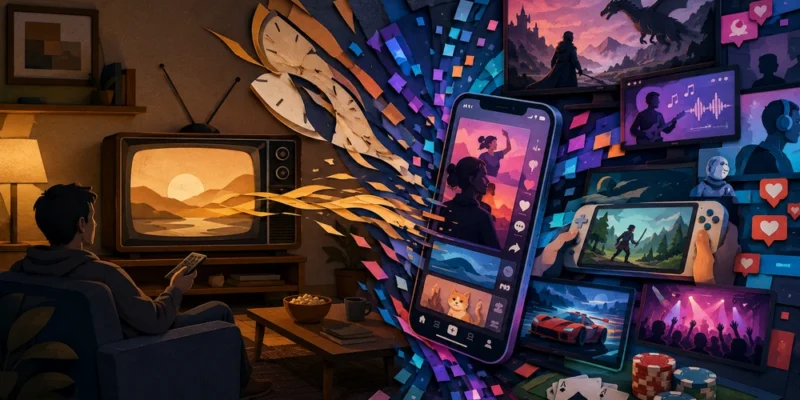
A decade ago, an evening of entertainment was a fairly predictable thing. You turned on a cable box, scrolled a printed or on-screen guide, and watched whatever happened to be airing. That ritual has come apart. The hours people once handed to scheduled television now scatter across a dozen apps, three or four screens, and a stream of content that rarely waits for an appointment. The shift sounds obvious until you look at how thoroughly it has rearranged the economics of an entire industry.
The headline is not that people stopped paying attention. It is that attention itself became the contested resource, and almost everyone is now fighting for the same finite pool of evenings and commutes.
Attention moved to the screen in your hand
The clearest signal of the change is what is happening to the television set itself. Streaming now regularly accounts for close to half of all viewing on US TV screens, according to Nielsen’s monthly tracking in its breakdown of TV usage, which splits total viewing between broadcast, cable, and streaming. Streaming has eclipsed broadcast and cable combined on more than one occasion, a milestone that would have read as wishful thinking not long ago.
But the television is only part of the story, and arguably the slower-moving part. The faster change is on the phone. Short-form video, mobile games, and social feeds have absorbed enormous chunks of the time that used to belong to a single screen in the living room. People watch in fragments now: ten minutes here, a half-hour there, often with a second device glowing in the other hand. The old idea of an audience settling in for the night has given way to something more restless and harder to measure.
Spending follows the eyeballs, eventually
Money has trailed attention, as it usually does, and the scale is striking. PwC’s long-running Global Entertainment & Media Outlook puts total industry revenue on a path toward the multi-trillion-dollar range later this decade, with the digital share of that spending climbing toward the clear majority. The growth is no longer evenly distributed. Internet advertising, streaming subscriptions, and video games are pulling forward while print and traditional broadcast revenue flatten or slip.
What makes the spending picture interesting is the friction inside it. Consumers are not bottomless wallets. Deloitte’s annual Digital Media Trends survey has documented a growing fatigue with rising subscription prices, with a meaningful slice of households trimming services or shifting to cheaper ad-supported tiers. The result is a market where companies keep adding products and customers keep doing arithmetic. Ad-supported streaming, once a fallback, has become a mainstream default precisely because people decided they would rather watch a few commercials than pay another monthly fee.
Interactive formats are eating the schedule
If one category captures where leisure is heading, it is the interactive kind. Gaming has stopped being a niche pastime and become a generational baseline. Deloitte’s research has found that a large majority of younger consumers identify as gamers, and they devote real hours to it every week, often more than they give to any single streaming service.
Interactivity is the common thread running through the formats that are growing fastest. Social platforms reward participation, not passive viewing. Games are interactive by definition. Live sports and live events draw crowds partly because they cannot be paused without losing the point of being there. Even streaming services are bolting on games, watch parties, and creator tools to keep people engaged between releases. Passive consumption still exists, but it is no longer where the energy is.
Real-money online gaming sits inside this wider current as one interactive slice among many. Regulated online casino and slots play has expanded alongside streaming and mobile gaming, drawing on the same habits: on-demand access, mobile-first design, and entertainment that responds to the player rather than scrolling past. Consumer-facing coverage reflects that, with mainstream outlets now publishing roundups of digital entertainment trends that treat real-money slots as part of the same online leisure economy as the shows and games people stream. The category carries its own responsibilities, and reputable operators pair the entertainment with clear limits, self-exclusion tools, and a steady reminder that it should stay fun and stay within a budget.
What the data agrees on
Read across the major sources and a consistent shape emerges, even when the exact figures differ. Attention is fragmenting across more screens and more formats. Spending is consolidating into digital channels, though consumers push back hard on price. And the formats winning the most time are the ones that ask the audience to do something, not just sit there.
Device habits underline all of it. The smartphone is the default first screen for a rising share of entertainment, and the television has quietly become just another connected device running the same apps. That convergence is why a streaming app, a mobile game, a short-video feed, and an online casino can all compete for the same idle twenty minutes. They are no longer separate industries occupying separate corners of life. They are neighbors on the same home screen.
The next few years
None of this points to a tidy endpoint. The likelier outcome is continued churn: bundles forming and dissolving, ad-supported tiers spreading, and personalization tools deciding more of what people see before they have chosen it. Artificial intelligence will sit underneath much of that, shaping recommendations and, increasingly, the content itself. The companies that thrive will be the ones that earn loyalty rather than assume it, because switching has never been easier.
For anyone watching the entertainment economy, the useful instinct is to stop thinking in old categories. Television, gaming, social, and online gaming are converging into a single market for human attention, measured in minutes and contested in real time. The leisure hour did not disappear. It just moved onto a smaller, brighter, more demanding screen, and almost everyone in entertainment is now organized around winning it back.
Comments